A set-formal-system is a formal-system that extends a first-order-formal-system with a particular collection of axioms. This collection of axioms (that are added to the axiomatic-system of the first-order-formal-system) is known as a set-axiomatic-system. Any variable in a set-formal-system is called a set, and is a formalization of the natural concept of collection.
Notation note: In the context of set-axiomatic-systems, a binary-predicate is historically referred to as a relation, and denoted instead of in what is known as the infix-notation.
The set-membership-relation is a relation (binary-predicate) that is completely defined by the set-axiomatic-system. The relation (in infix-notation) is read as “the set contains the set ”, or “the set is an element (or member) of the set “. Given a set , in general, we list all its elements (i.e. all the sets that satisfy ) between brackets, e.g., we write the set of vowels as . A set that contains just one element is called a singleton (e.g. ), a set that contains two elements is called a pair (e.g. ), and a set that contains three elements a triplet (e.g. ). The number of elements in a set is known as its cardinality. So we can say for example, that a singleton has cardinality 1, a pair cardinality 2, and a triplet cardinality 3, the set of vowels cardinality 5, etc.
The set-membership relation , let us define four other useful relations:
- called the not-member-relation and read as “the set does not contain the set ”, or “the set is not an element of the set ”
- called the subset-relation and read as “all the elements of are elements of ” or simply “the set is a subset of the set ”
- (or equivalently ) called the proper-subset-relation and read as “the set is a proper-subset of the set ”
- called the equal-relation and read as “the set is a equal of the set ”
Before talking about set-axiomatic-systems we will introduce one last type of relation that is fundamental in all of mathematics and for which we will dedicate its own section.
maps
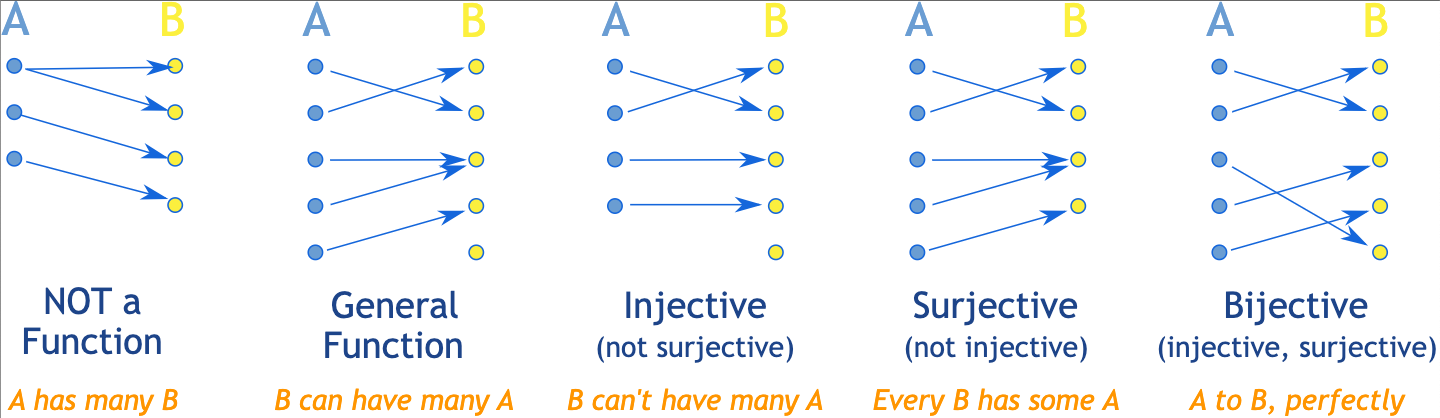
A map (or function) is a relation between the elements of two sets that satisfies . Since is unique we can write . The elements are known as input and output respectively, and the sets are known as the domain and codomain of respectively. Given a subset , the set of all the inputs whose output is in , i.e. is called the preimage of under and denoted . Note that . Given a subset , the set of all the outputs we obtain by applying to , i.e. is called the image of under and denoted . If the subset is directly the whole domain is called just the image of and denoted . Note that the image of any subset is a subset of the codomain . If the image of is the whole codomain , i.e. every is an output of some , we say that the map is surjective. If there are no two different outputs with the same input (i.e. ) we say that the map is injective. Note that if is surjective and injective, then every element of the codomain is the output of a unique element of the domain, i.e. , in this case is a one-to-one mapping of the domain and the codomain and we say that is bijective. In some cases, instead of saying that the map is injective, surjective or bijective, we say that is an injection, a surjection, or a bijection. A bijection from a set to itself is a permutation. The more standard example of a permutation is the identity-map, that maps every element to itself, i.e. . The set of all the bijections from a set to itself (permutations) receives the name of the symmetric-set of and is denoted as . If there exists a bijection between to any pair of sets and , we say that they are isomorphic-sets, denoted . Given 2 maps and , the map read as ” after ” is known as the composition of and . We saw that a bijection is a one-to-one mapping of the domain and the codomain, having each a unique corresponding s.t. . We could then have a map that returns for each that unique , such map is known as the inverse-map of , denoted and is completely defined by (where is composition and the identity-map). If a map has a inverse-map, we say that it is invertible. A permutation that is its own inverse-map is known as an involution.
zfc-set-formal-system
The search for whether there exists a set-axiomatic-system capable of deriving all currently known mathematics has been long and fascinating. This quest led to the formulation of a set-axiomatic-system consisting of 9 axioms, known collectively as ZFC. Below, we will present these 9 axioms—first in plain English, and then in predicative-formal-language. (Recall that these axioms are added to a first-order-formal-system, and are therefore formally expressed in a predicative-formal-language.)
axiom-of-extensionality
Informal version: Two sets with the same elements are the same set.
Formal version:
ordered-sets
We have seen that the elements of a set are specified within brackets. The set of vowels , which we previously wrote as in alphabetical order, could also be written as —and it would still be the same set, since it contains the same elements (the same holds for any other order we might choose to list the vowels). This is why it is generally said that sets have no intrinsic order: any order in which we list their elements corresponds to the same set. However, it is often useful to refer to the elements of a set in a specific order. For this purpose, we define the notion of an ordered-set (or tuple) as follows. We’ll start with the example of a pair, since a singleton only has one possible order. Given a set with two elements and (a pair), both and refer to the same set . But using the same elements, we can define the ordered-set or the ordered-set . Note that , but because they do not have the same elements: the first contains , while the second contains instead. In the same way, from a set of three elements (a triplet) , we can define the ordered-set , or the ordered-set , etc. An ordered-set of four elements could, for example, be defined as , and by continuing in this way, one can define an ordered-set of any cardinality. An ordered-set of 2 elements is called an ordered-pair (or a 2-tuple), and an ordered-set of 3 elements is called a triple (or a 3-tuple).
axiom-of-pairing
Informal version: Given two sets and , then the pair is also a set.
Formal version:
axiom-of-union
Informal version: Given a set , the union-set is a set.
axiom-of-replacement
Informal version: The image of a set under any map is a set.
https://us.metamath.org/mpeuni/mmtheorems53.html#mm5279b
axiom-of-regularity
Informal version: Every non-empty set contains a set disjoint from itself.
One consequence is that it denies the existence of a set containing itself
axiom-of-separation
axiom-of-power-set
axiom-of-infinity
axiom-of-choice
summary
Axiom-of-extensionality (E): Two sets with the same elements are the same set. Axiom-of-pairing (P): Given the sets and , then the pair is a set. Axiom-of-replacement (R): The image of a set under any map is a set. (scheme) Axiom-of-union (U): Given a set , the union-set is a set. Axiom-of-regularity (G): Every non-empty set contains a set disjoint from itself. Axiom-of-separation (S): (scheme) Axiom-of-power-set (W): Axiom-of-infinity (I): Axiom-of-choice (C):
TOC of Theorem List - Metamath Proof Explorer
Este sistema consiste de 9 axioms , pero ha quedado de esta manera for clarity and ease of use ya que se ha mostrado con el tiempo que varios de los mismos son redundantes.
useful-definitions
todo definir antes tal vez estas cosas
cartesian product disjoint. (se usa en Axiom-of-regularity) union-of-sets
Given a set , a partition is a collection of non-empty subsets , that are pairwise disjoint ( for any ) and whose union is the whole set, i.e. .
relations
A reflexive relation satisfy (i.e. ), an irreflexive if , a symmetric , an asymmetric , an antisymmetric , a total , a transitive , and finally, an antitransitive . A transitive relation is called a preorder (R) if it’s reflexive, and a strict-preorder (I) if it’s irreflexive. A total preorder is called a total-preorder (RT), and a symmetric preorder an equivalence (RS). An antisymmetric total-preorder is a total-order (RTA), an antisymmetric equivalence is an equality (RSA), and an antisymmetric preorder is called a partial-order (RA). A symmetric total preorder (RTS), or equivalently, a total equivalence (RST) is known as a universal-relation. Note that total implies reflexive, and since a strict-preorder is by definition irreflexive we need a word for a relation that is “total but not reflexive” (i.e. the total condition does not hold for ), and that word is comparable. So a strict-total-order (IC) is a strict-preorder that is comparable. If the strict-preorder is not comparable, but the elements that are not comparable are equivalent, then it’s called a strict-partial-order.
Note that a total-order is also a total partial-order (RAT), an equality is also a symmetric partial-order (RAS), and a universal-relation is also a total equivalence.
A transitive relation is asymmetric iff it’s irreflexive. So in the definition of strict-preorder we could’ve used asymmetric instead.
A strict-total-order is vacuously antisymmetric (the comparable and transitive properties make impossible to have ) so is an irreflexive total-order. (In letters, an IC (strict-total-order) is necessarily an ICA. So to make a total-order (RTA) irreflexive, is to change the R for an I, and the T becomes a C (total but irreflexive is comparable) obtaining an ICA (strict-total-order)).
equivalence-classes
Given an equivalence-relation over a set and an element , the set is called the equivalence-class of and is known as the representative of the equivalence-class. In general is just denoted . The set of all the equivalence-classes of (removing duplicates) is known as the quotient-set and denoted . The surjective map that sends each element to its equivalence-class is known as the quotient-map, and a choice-of-representatives is an injective map that sends every equivalence-class to a representative.
Note that the map-composition is the identity-map over .
Properties:
- Any can be a representative, i.e. .
- Different equivalence-classes are disjoint, i.e. .
- Every equivalence-relation induces a partition of denoted (the quotient-set), and conversely, every partition of defines an equivalence-relation ( if they are in the same subset of the partition).
number-sets
natural-numbers integer-numbers
Well definition on a quotient-set: Care must be taken when defining maps whose domain is a quotient-set if one uses a choice-of-representatives. In order for it to be well-defined one needs to show that the map is the same under any choice-of-representatives.
rational-numbers