We saw in the previous entry, that a collection of formation-rules (the formal-grammar) indicate which formulas are well-formed and form a formal-language. Now we will go a step further by marking some of the wffs of a given formal-language as theorems. This is done again by a collection of rules, known as inference-rules. The collection of inference-rules that we decide to use is known as an inference-system. Unlike a formal-grammar, an inference-system requires a starting point. This is, it marks wffs as theorems using previous theorems (action that is known as “to infer a theorem”). To avoid this recursion, a collection of wffs (known as axiomatic-system) is chosen to be arbitrarily marked as theorems in order to start the process. Each of the wffs of the axiomatic-system is called an axiom. All wffs that can be marked as theorems depend on the formal-language (), the inference-system (), and the axiomatic-system (). The formal-language () defines all the wffs that can be marked as theorems, the inference-system () specifies the rules for marking them, and the axiomatic-system () provides the initial theorems to begin the process. This triplet is then very important as a whole and that is why it receives a name, i.e. a formal-system (). Once we choose a formal-system , the collection of wffs of that will be theorems is automatically defined. This collection is known as the theory.
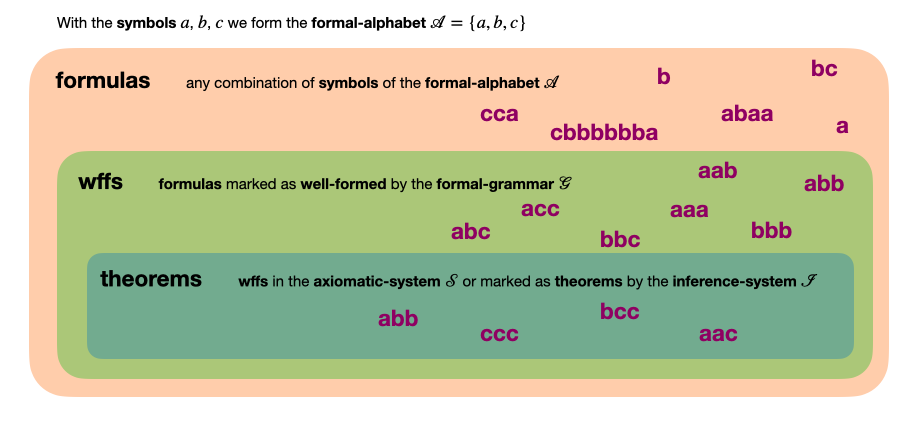 In the previous entry, we saw that the formal-language is formed by all the formulas that can be created as combinations of symbols of the formal-alphabet , and are marked as well-formed-formulas (wffs) by the formation-rules of the formal-grammar. In the image above, the formal-language (defined by ) is formed by all the formulas (in purple) that are inside the green area, i.e. all the formulas that are marked as well-formed using the formal-grammar (all the wffs) are the 10 formulas (check the example in m1-formal-language). Then we if we choose an axiomatic-system (i.e. we chose some of these wffs (e.g. and ) to be marked as theorems), and an inference-system , we have defined the formal-system . All the wffs that can also be marked as theorems using this formal-system (i.e. all the wffs that can also be marked as theorems by the inference-rules of starting from the axioms and of ) form the theory . In the image above, we suppose that all the wffs that can be marked as theorems starting from and using are and , so the theory defined by the formal-system is formed by the four theorems (the blue area of the image).
Notation note: It is common when talking about formal-systems to refer to the action of marking a wff as a theorem following and , as to prove the theorem . So we often hear of a theory as “the collection of all the wffs that can be proven from the formal-system “.
zeroth-order-formal-system
Any formal-system that uses as its formal-language the propositional-formal-language is called a zeroth-order-formal-system. As we saw, in a formal-language a wff is a proposition. In a zeroth-order-formal-system a theorem will be a True proposition, and to prove a theorem will be to infer that it is True.
inference-rules
A zeroth-order-formal-system deals with propositions, and their truth-values, then the things to be inferred will be truth-values of propositions. For example, suppose we are told that the proposition is a theorem (i.e. a True proposition). If we look at the definition, the only combination of truth-values of and for which it is True is both and , so, if we are told that is theorem, then we know that both and are theorems too (True propositions). This is an inference. We are told that is a theorem (i.e. that is True), and nothing about the truth-values of the propositions and , but this information is implicit in the logical-connective definition itself. This is, this information is not directly given to us, we are just told that is a theorem, but we can “infer” that they are theorems too since the only combination of truth-values of and for which is True is when both and are True.
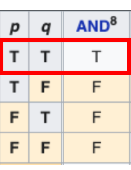 If we are told that a given collection of propositions (known as premises) are theorems, and if for all cases for which these propositions are True, some proposition (called the conclusion) is also True, we say that we can infer from (being theorems) that is also True. This is nothing more than what we have called an inference-rule and is symbolically represented as . For the case of this rule is called simplification and is represented as . Note that we can also use simplification to infer , i.e., . Conversely, (and as an example of an inference-rule of more than one premise) we can be told that the two propositions and are premises (therefore theorems, therefore both True) and from that infer that is True (note that again that for the only row where both and , we have ). This inference-rule represented as is called conjunction.
Note, however, that not from every theorem (or collection of them) we can infer something. For example, is not an inference-rule, since if we are told that is a theorem, we have three possible combinations of values of and that makes it True, and in two is True, but in the other is False. If from a rule we can actually infer the conclusion , we say that the rule is valid, if not (as in the case of ) we called it a fallacy. A valid rule then is one in which is impossible for all the premises to be True while the conclusion is False. A sound rule is a rule that is valid and all its premises are True.
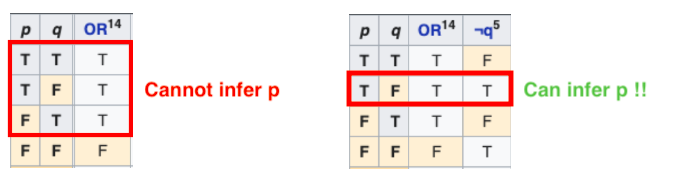 However, if we add to the premise , the only combination where both are True is and so we then can actually infer as a theorem. Then is a fallacy, but is an inference-rule, called disjunctive-syllogism. Note that we can also use the disjunctive-syllogism to infer by adding as a premise (i.e. ).
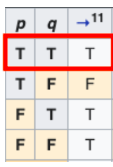
Other very commonly used inference-rule in a zeroth-order-formal-system is , known as modus-ponens. We can again, looking at the definitions, that for all cases for which the premises are True (just one in this case), is True.
 Suppose we are given and as premises. Using the contrapositive-law (that we introduce in the previous-entry) we have that is a theorem. And from it and we can infer using modus-ponens (). This inference-rule, represented as , is called modus-tollens and is a variance of the modus-ponens using the contrapositive-law.
Note: Since if we are given two premises , we can infer (using conjunction) that is a theorem, and conversely, if we are given as a single premise we can infer (via simplification) as two different premises. For this reason, in the collection of premises, or are used interchangeably to state that both and are premises. For example, in some texts you can find the disjunctive-syllogism rule written as , the modus-ponens rule written as , the modus-tollens rule as , etc.
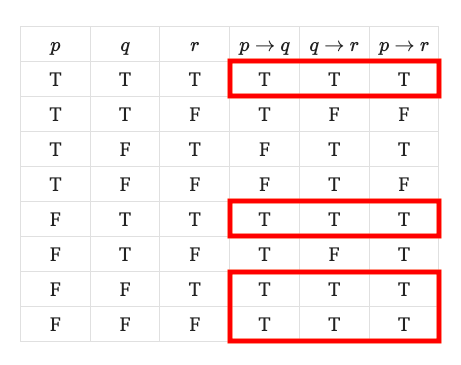
As a final example, and as an example of an inference-rule with three different atomic-propositions we’ll present the case of the inference-rule known as hypothetical-syllogism. Again, if you look in the next table, you’ll see that for all cases for which both and are True, the proposition is also True. Therefore, from the propositions and we can actually infer , making the hypothetical-syllogism a valid inference-rule.
fallacies
As we saw, a rule from which we cannot actually infer the conclusion is called a fallacy. F.e., we saw that, unlike the disjunctive-syllogism that is a valid inference-rule, the rule is a fallacy since there are cases of which is True that is False. Many fallacies receive a name, f.e. is called the affirming-a-disjunct-fallacy. Unlike the modus-ponens (), the rule is a fallacy (called the affirming-the-consequent-fallacy), since (as you can check in the following table) when and are both True, could be False.
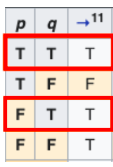
Other example of a common fallacy is , known as the denying-the-antecedent-fallacy. Note that is True when is True (i.e., is False) for both values of (and therefore both values of ).
examples
We saw that a zeroth-order-formal-system a formal-system that uses the propositional-formal-language as its formal-language . Thus, the different types of zeroth-order formal systems are defined by different combinations of inference-system () and axiomatic-system (). Now that we’ve explored some common inference-rules of a zeroth-order formal system, let’s examine a few concrete examples to illustrate how these systems are constructed and applied.
axiomatic-formal-systems
The first type of of zeroth-order-formal-system we’ll talk about is known as axiomatic since they all have an inference-system that contains just one inference-rule (the modus-ponens i.e. ), and therefore, their power comes from the intelligent choice of axioms for the axiomatic-system. The first system of this kind was formally described by Gottlob Fredge in his 1879 book called “Begriffsschrift” (for what is called Frege-axiomatic-system) and had the following six axioms:
- Axiom 1:
- Axiom 2:
- Axiom 3:
- Axiom 4:
- Axiom 5:
- Axiom 6:
Jan Łukasiewicz showed in 1930 that, in Frege-system, “the third axiom can be derived from the preceding two, and that the last three axioms can be replaced by the single one , reducing the number of axioms to just three, in the system known as Łukasiewicz-axiomatic-system :
- Axiom 1:
- Axiom 2:
- Axiom 3:
Finally, and to end a search of many years, in 1953, Carew Meredith showed that the number of axioms can be incredibly reduced to just one, obviously known as the Meredith-axiom.
- Axiom: This axiom, allows to have a zeroth-order-formal-system (called the Meredith-axiomatic-system) that not only has an inference-system of a single inference-rule (the modus-ponens), but also an axiomatic-system of a single axiom (the Meredith-axiom).
Note: todo axiomatic-formal-systems using only NAND (list in this article) and Wolfram’s axiom
inference-formal-system
The other type of zeroth-order-formal-systems are known as inference-formal-systems (or formal-systems based on inference) since they take a different approach by eliminating axioms entirely and instead, relying purely on a rich inference-system. The best known consists of 11 inference-rules designed to mimic the natural reasoning processes of mathematicians. They are modus-ponens, disjunctive-syllogism, conjunction, and 8 more listed and explained here. By starting without axioms and building proofs step-by-step using these rules, this system provides a flexible framework for constructing proofs that feels more intuitive. This approach contrasts with the axiomatic-formal-systems, emphasizing process over initial assumptions.
first-order-formal-system
Any formal-system that uses as its formal-language the predicative-formal-language is called a first-order-formal-system.
En general un first-order-formal-system extends a zeroth-order-formal-system by adding machinery to handle predicates, quantifiers, and variables. El ejemplo más conocido y utilizado, llamado Hilbert-firsrt-order-formal-system extends an axiomatic-formal-system que vimos pueden ser reducidos a tan solo un axioma (the Meredith-axiom) by extending its propositional-formal-language to a predicative-formal-language with as the unique quantifier (remember that we can derive the rest from any other quantifier), and extending the axiomatic-system with the following three axioms:
Q5. where may be substituted for in Q6. Q7. where is not free in .
The wikipedia-article says also that we can, equivalently have the Hilbert-firsrt-order-formal-system by adding just the axioms Q5 to the axiomatic-system, but adding to the inference-system the predicative inference-rule known as universal-instantation que hace redundantes a Q6 y Q7.
todo investigar y explicar bien este último párrafo.
properties-of-formal-systems
As we saw, we say that we prove (inside a formal-system ) a wff of the formal-language if we can mark it as a theorem applying inference-rules (of the inference-system ) over axioms (of the axiomatic-system ) or other theorems previously proved. We say that we disprove a wff of when we prove its negation .
A formal-system is consistent if for every wff in we cannot both prove it and disprove it, i.e. if we cannot prove both and its negation as theorems.
Note: In a not consistent formal-system there exists a wff such that both and are theorems, then we can prove as a theorem any wff (since if is a contradiction that let us prove any wff using the modus-tollens ()). So, by contraposition, a formal-system is consistent if it does not contain contradictions, or equivalently, if we cannot prove any wff.
A formal-system is complete if for every wff in we can prove it or disprove it.
A formal-system is decidable if for any wff in there exists an algorithm that can determine whether it is a theorem.
todo hablar antes de qué joraca es formalmente un algorithm